
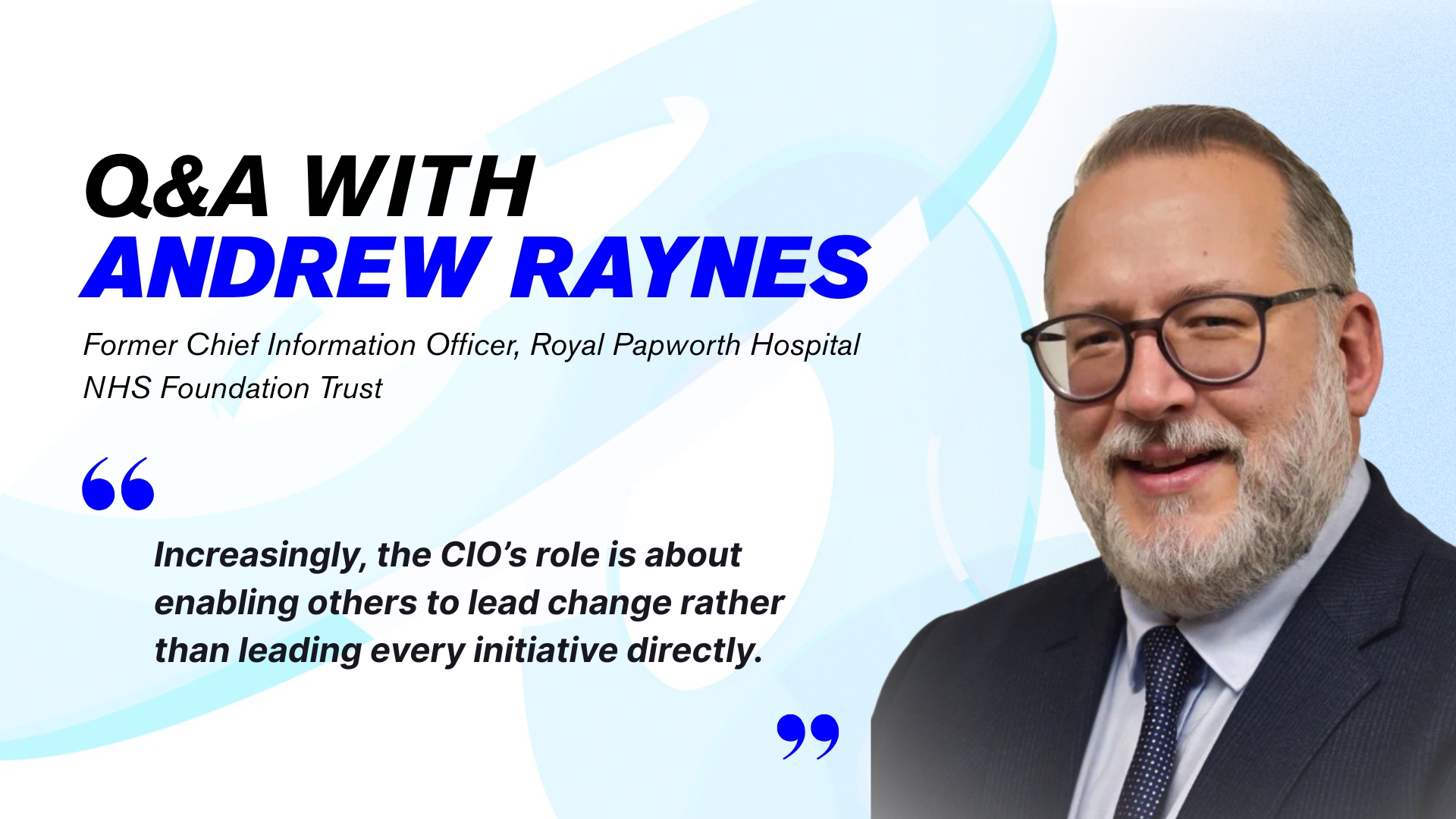
Andrew Raynes: Why Successful Healthcare Transformation Requires CIOs to Lead Beyond Technology
An interview with Andrew Raynes, former Chief Information Officer, Royal Papworth Hospital NHS Foundation Trust and a globally recognised leader in healthcare transformation and digital innovation.
Automation has become a strategic priority across the NHS, yet many organisations still approach it as an IT project or a collection of point solutions. Through our work with more than 70 NHS organisations, we’ve seen that the greatest value comes when automation is treated as an organisational transformation— redesigning end-to-end processes to enable better ways of working.
To explore what successful transformation looks like in practice, we spoke with Andrew Raynes, former Chief Information Officer at Royal Papworth Hospital NHS Foundation Trust. With more than 25 years’ experience in healthcare and the public sector, Andy shares why successful automation depends as much on people, processes and culture as it does on technology—and what NHS leaders need to do to unlock its full potential.
Q&A with Andrew Raynes
Q: Why do many NHS organisations approach automation as an IT deployment rather than a transformation programme?
Andy: There is something about making an improvement through automation/tech but not understanding that difference it will make to sufficiently adapt let alone exploit it. In some organisations, digital is still seen as a cost centre rather than an enabler of change.
For me, successful transformation is about people, processes and technology working together. You can purchase automation software but implementing it at scale fundamentally changes business processes and often the roles of the people involved. That’s where the real challenge – and opportunity – begins.
Automation isn’t simply replacing repetitive tasks. It’s redesigning end-to-end processes, understanding how work changes, bringing people along on that journey, and ensuring technology enables staff to focus on more valuable and meaningful work.
Ultimately, project leaders need to think about all three elements—people, process and technology—and understand how each will be affected by the transformation.
Q: Where do end-to-end automation programmes typically break down?
Andy: There are three common failure points.
First, organisations don’t always have a clear vision of the future state. Without understanding where you’re trying to get to, it’s difficult to design the journey. That’s why defining both the current (“as-is”) and future (“to-be”) processes is so important.
Second is change management. Communication, education and empathy are essential. People need to understand why change is happening, what it means for them, and how they’ll be supported. If you fail to take people with you, the disconnect begins long before technology is implemented.
The third challenge is technology reliability. Even after months of preparation, if the technology fails on day one, confidence disappears almost instantly. Thorough testing and ensuring the solution works from the outset are critical to maintaining trust across the organisation.
Q: How do you see the role of the CIO evolving as organisations embrace automation and AI?
Andy: Increasingly, the CIO’s role is about enabling others to lead change rather than leading every initiative directly.
The people closest to clinical or operational work are often the strongest advocates for new technology because they understand both the challenges and the opportunities. Their peer-to-peer influence is incredibly powerful.
In healthcare, I often describe successful transformation as clinically led, operationally delivered and digitally enabled. Digital provides the tools and expertise, but lasting transformation happens when the business owns the change.
But it is not only the CIO’s role that is evolving. Everyone involved in these new ways of working will need to adapt and take on new roles and responsibilities. Leading this transition effectively—and providing the right support to help people develop new skills and adapt to change—is essential to bringing the wider organisation with you.
Q: How should healthcare organisations be measuring the impact of automation?
Andy: Start by being realistic.
Business cases often assume optimistic benefits, but in reality, outcomes rarely achieve the absolute maximum expected. Setting achievable goals makes success more meaningful and creates opportunities to exceed expectations.
Equally important is shared ownership. Benefits shouldn’t sit solely with digital or transformation teams—they need to be jointly owned by operational leaders and those responsible for delivering the change.
I also think we should move beyond simply talking about benefits and instead focus on value. Value considers both what you’ve invested and what you’ve achieved. Sometimes a lower-cost project delivering 80% of the expected benefits creates more value than an expensive programme delivering only 40%.
Understanding your baseline before the project begins is equally essential. Without knowing your starting point, it’s impossible to accurately measure improvement afterwards.
Q: How can organisations balance patient perspectives with staff experience when redesigning care pathways?
Andy: The answer is inclusion.
Recently, at Royal Papworth, we invited a patient representative into one of our process modelling workshops alongside our clinical administration team. It gave us an entirely different perspective.
Patients ask questions that professionals often don’t think to ask. Seeing the process “under the bonnet” helped them understand the complexity while also highlighting pain points, we’d become accustomed to.
The workshop led directly to practical improvements. For example, changes to telephone routing reduced call waiting by 39% for one clinic.
User groups—whether patients or staff—are incredibly valuable, but only if organisations act on the feedback. Listening is only the first step. Building confidence comes from showing people that their input leads to meaningful change.
Q: What excites you most about AI and intelligent automation in healthcare?
Andy: What motivates me most is seeing technology genuinely make a difference.
There’s nothing more rewarding than hearing someone say, “That really improved how we work” or “That made care better for our patients.”
AI and automation have enormous potential to help an increasingly stretched healthcare workforce by removing administrative burden and allowing skilled professionals to spend more time doing the work that only humans can do.
But alongside that opportunity comes responsibility.
Concerns around data protection and cybersecurity are valid, and open discussion is essential if we are to continue developing proactive safeguards against these risks. As AI adoption grows, we also need to think carefully about ethics, sustainability and environmental impact.
The computational power behind AI is significant, and we all have a responsibility to ensure these technologies are used thoughtfully and for the greatest possible benefit.
The future is incredibly exciting—but it must also be responsible.
Final thoughts
Andrew’s message is clear: the technology is rarely the limiting factor. Organisations achieve the greatest value when leaders create a clear vision, redesign processes, and bring people with them through change.
Luckily, no organisation must navigate transformation alone. Learning from peers can help avoid common pitfalls, accelerate delivery and realise greater value.
Join our free NHS peer community, created exclusively for NHS professionals and partners to explore real-world case studies, practical lessons and proven approaches from organisations delivering automation and transformation at scale.
Other resources:
A research study by Veera Häkkinen (Digital Workforce Healthcare Solution Consultant) about the new roles and responsibilities healthcare professionals are taking on as AI is integrated into care processes. The study explores these roles in the context of the EU AI Act and its requirements and compares different levels of human oversight through practical scenarios:
https://trepo.tuni.fi/handle/10024/236238
The UK government’s Code of Practice for the Cyber Security of AI (2025): https://www.gov.uk/government/publications/ai-cyber-security-code-of-practice/code-of-practice-for-the-cyber-security-of-ai
The UK government’s Report on Environmentally Sustainable AI (2025): https://nepc.raeng.org.uk/media/2aggau2j/foundations-for-sustainable-ai-nepc-report.pdf
A case study in transforming breast cancer follow-up at Helsinki University Hospital—sharing measured outcomes and exploring when to use algorithmic automation versus AI for maximum impact and secure control:
https://digitalworkforce.com/rpa-news/hus-care-pathway-automation/