
Finish customer requests during the call
Your customer calls, says what they need in their own language, and hears it done before the call ends. Digital Workforce with boost.ai answers the call at any hour and runs the work behind it to completion.
Self-service left the hard requests on the phone
Every self-service project moves the simple requests out of the queue. Opening hours and order statuses.
What stays on the phone is what people could not finish elsewhere. It also holds everything they did not trust a form to handle.
Better routing does not fix that. Callers can now say what they want instead of pressing a number, but the request is still not finished. An advisor still opens two or three systems, makes the change and reads it back.
So the calls get harder and the volume stays the same. The caller waits twice, once for the routing and once for the work.

Phone contacts cost more to answer
A call that needs authentication and case handling costs far more than a routine answer. Automation finishes the same request for a fraction of that.
Published research says the same. Gartner puts a self-service contact at USD 1.80, against USD 13.50 for an assisted one.
Requests that do not finish keep your queue long. At worst, customers leave because they get tired of waiting.
Count finished calls, not handled ones
Handling time describes how the contact centre works. It does not say whether the caller got what they called for.
In addition, count the calls that finish end to end, from the greeting to the change saved in your system of record. Digital Workforce runs the call and the work behind it as one service. Learn more about Customer Service Automation.
You may not use voice agents yet. You may have tried them and not got the quality or control you needed. Either way, talk to us about the next step.
The voice AI agent understands what the caller means
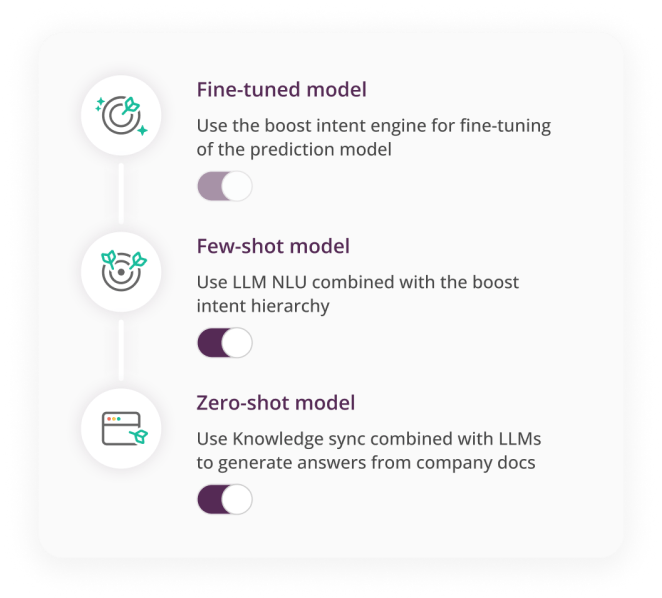
The voice AI agent interacts with the customer with voice and uses Large Language Models (LLM) to understand what the caller means. The conversational layer runs on the boost.ai platform.
The voice agent detects the caller's language and replies in that language. It repeats ID numbers and dates so the caller can confirm them.
A mis-heard digit becomes clear during the call. The caller can interrupt, and the voice agent stops talking.
The same service sits behind the call and behind chat, with the same integrations and back-office automation. Only the channel changes. What you build for chat also works on the phone. Learn more on the AI agents page.
The voice service has four parts
- The voice agent sits in front of your existing contact centre platform
- Voice and chat share the same AI agents, guardrails and reporting
- You set, per call reason, what the voice agent may say, what it reads back and when it hands over
- Recording, transcripts and how long you keep them follow your call policy.
Nordic languages are ready for voice
Nordic speech quality has matured
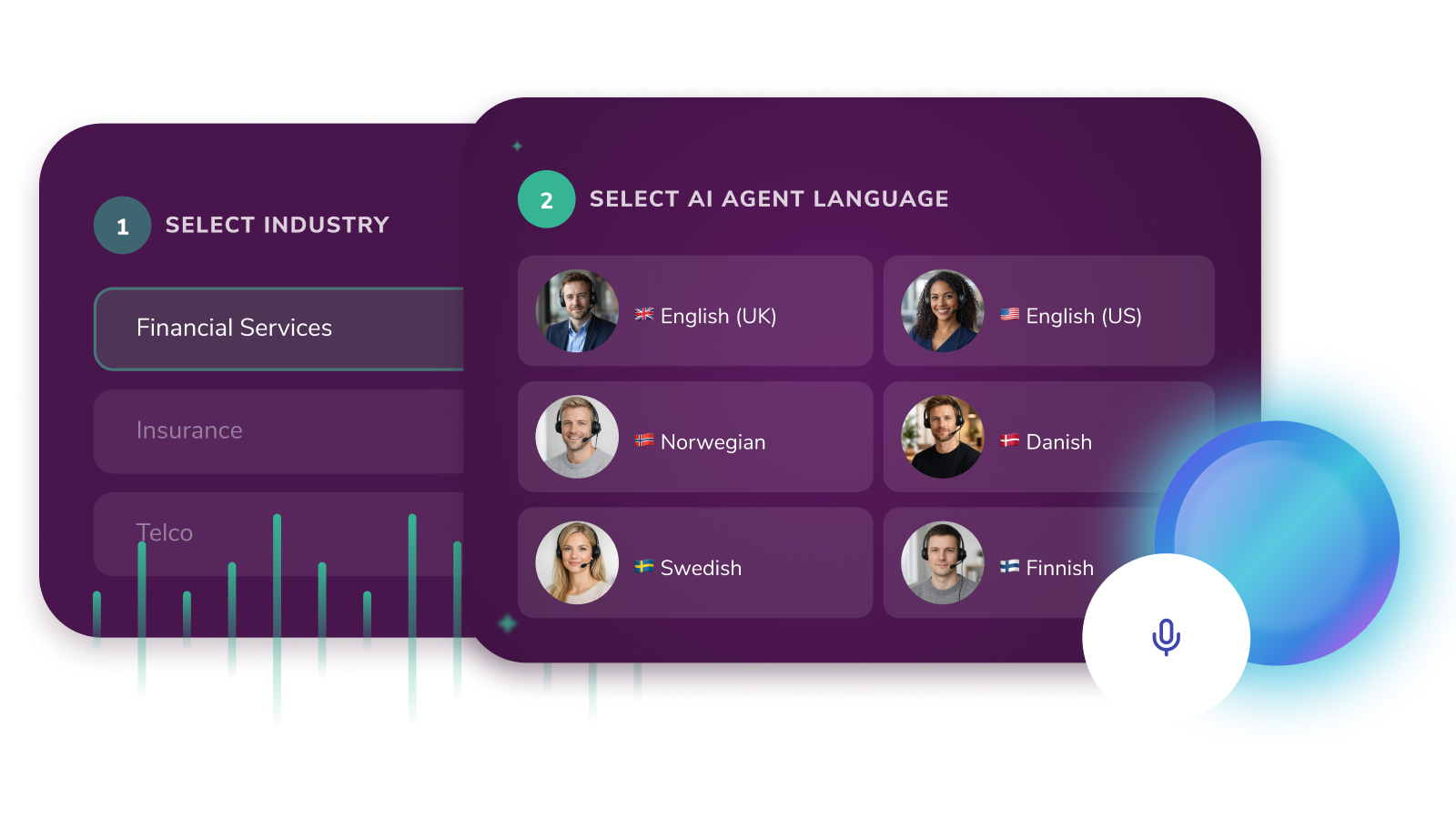
Voice AI agents have been good in English for years. In the Nordic languages, dialect, compound words and half-finished sentences were the hard part. Finnish, Swedish, Norwegian and Danish have now improved sharply, and they are ready for everyday service. That is why voice belongs on your roadmap now.
The public sector is first to adopt
Public agencies are among the first to put voice services into production. The standard they set is clear: the service must be at least as good as a person.
Banks, insurers and large consumer businesses are following.
Authentication comes before anything else
In regulated services nothing useful happens until the customer has been authenticated. The voice agent verifies the caller's identity through the services you already run. External services use strong authentication through government-approved providers. Internal services check identity through Azure Active Directory, or any other way you prefer.
Once the caller is authenticated, the voice AI agent can personalise the call. It knows the customer's services and past contacts, handles the request in your back-office systems, and can offer what fits this customer before the call ends.
Where your system has an API, the service calls that API. Where there is none, our intelligent automation uses the system the way your people do.

Most vendors leave this part to you. Digital Workforce has run business-critical services since 2015. That work covers more than 200 large customers and more than 5,000 automated processes.
Authentication and integration have five key elements
- We authenticate the customer with the method you already use, agreed per service, including strong authentication where it is required
- Connection to your back end by API where one exists, and by intelligent automation where there is none
- Every action in your back-end systems runs under a named service account, with the rights a person would hold
- The voice AI agent confirms the service that was performed
- Digital Workforce runs the integrations and the automation, and improves the service every month.
Handover gives the advisor the whole case
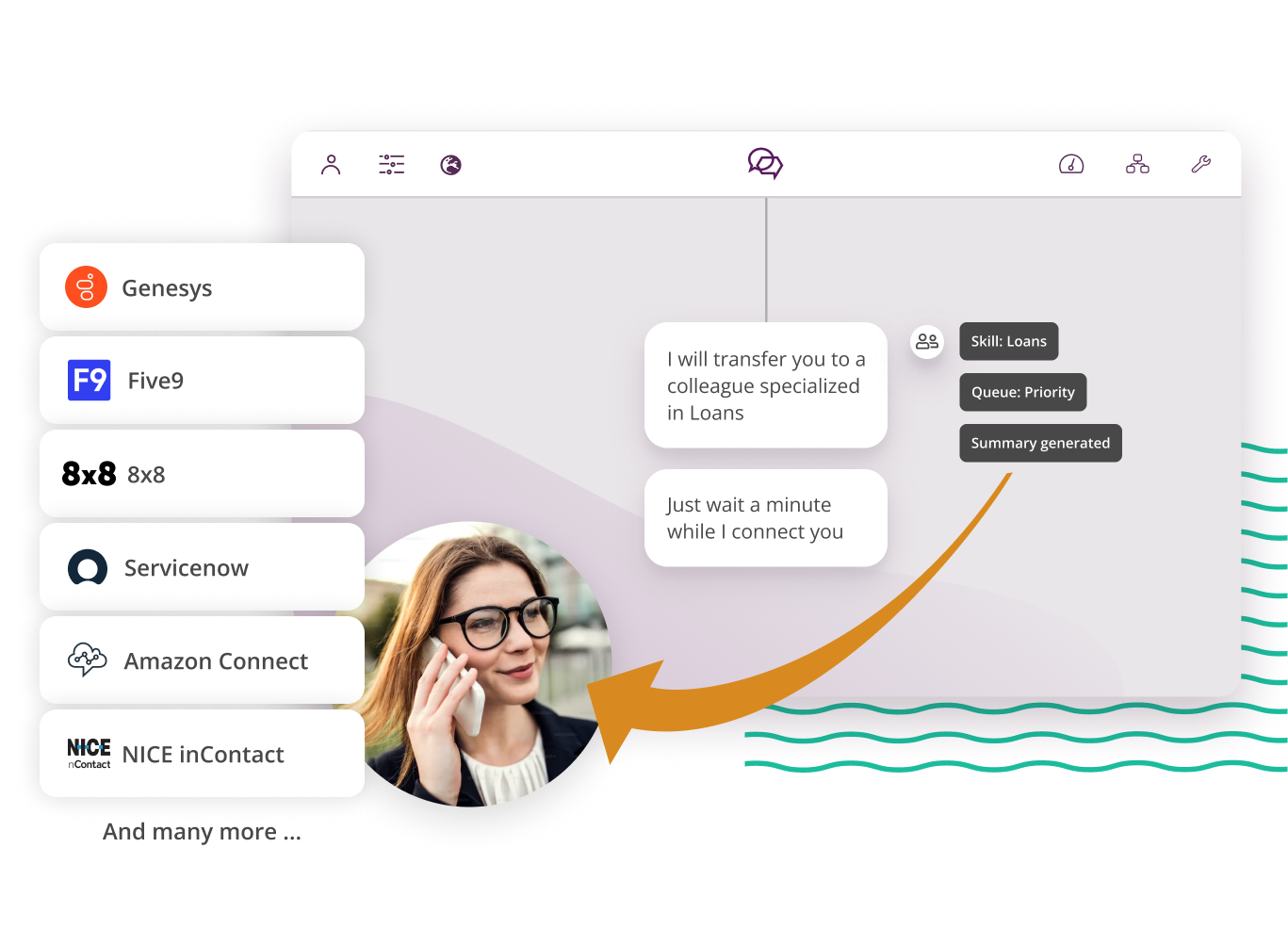
A machine should not finish every call. Hard decisions, upset callers and anything where a small error is costly go to a person to handle the case.
Handover is a warm transfer to a named queue. The advisor gets the authenticated customer, the conversation transcript, and a summary of what the customer and the voice AI agent have done so far.
Voice AI agents can also call your customer
Most voice automation waits for the phone to ring. Digital Workforce's Customer Service Automation can also make the call.
Voice AI agent can proactively confirm a scheduled appointment and offer a new time. A customer who has given notice gets a retention call. A case waiting for one more document gets a reminder.
Outbound calls work best with customers you already serve. That is also where a retention offer or the next sale can be made.

Callers finish the request without waiting


Instant answer at any hour, including nights and weekends

Service in their own language, Finnish and Swedish

No menu tree and no hold music for a routine change

The request finished and confirmed during the call

A channel that needs no app or portal
Prove it on one call reason
You do not have to decide about the whole channel. Pick one call reason with real volume and a clear finish, such as an appointment confirmation, an invoice due date or a service change.
We build and run the voice AI agent against your systems. Then we measure how many callers end the call with the request finished, and how the experience felt to them.
Voice AI agents are proven in many ways
- Share of calls completed end to end, and why the rest did not
- Time from greeting to confirmation, and how that compares with your handling time today
- How well the service understood the language we tested, with the failures listed
- What is needed to add the next three call reasons
The automation behind the call is proven
Voice AI is the new channel, especially in the Nordics.
The automation that finishes the request is Digital Workforce's core business. We orchestrate and run the processes behind the front door for regulated organisations, under tight service agreements. This part of the service has a decade of production history.
You buy the completed request. That is service as software: one agreement, one SLA and one named service manager. Whatever does not finish is ours to improve.
Learn more about Customer Service Automation and how to give every customer a premium experience.

Buyers ask us these first, so we answer them here
The first session starts with your priorities
The session works best when we hear from two people. One is your business director, who owns the P&L. The other is your customer service director, who owns the problem. If an AI committee signs off new AI services, bring its lead too.
You leave with a picture of the market. You see how others in your industry have started using customer service automation, and what results they got.