

The nine steps your procurement team runs before deciding
Part 1 of 4 · Autonomous procurement operations
None of it is difficult. Somebody has to do all of it.
It is Monday morning. One of your suppliers has sent an email. From next month, the prices they charge you go up by 4.8%, across everything you buy from them.
Nothing about that email is unusual. A supplier has asked for more money for the same goods, and you get some version of it most weeks, from some supplier, in some category. It is not a crisis, nobody escalates it, and it will be handled.
Watch what has to happen before it is.
A supplier asks for a 4.8% price increase
Somebody has to:
- Find the contract
- Read the indexation clause
- Check the correct index
- Calculate the increase the contract actually permits
- Decide whether to challenge it
- Talk to the supplier
- Update the agreed price
- Make sure future orders use the new one
- Weeks later, check that the invoices follow it
That is nine steps, and none of them is difficult. Any competent person in your team can do any one of them, and most of them are dull. The problem is that somebody has to do all of them, in order, for this supplier, this month.
And this is one email. One supplier. One price change.
Now multiply that by the thousands of suppliers and contracts you are responsible for, and by every purchase, commercial change and exception that arrives across a year.
Nobody in your organisation has ever seen that total, because no system holds a line called hours spent finding things. Your ERP records the order and your contract system records the clause, but neither of them records the forty minutes somebody spent working out which clause applied. So the work stays expensive and invisible at the same time, spread across hundreds of people who each experience it as a small annoyance.
Small annoyances do not get put on a board slide. They get absorbed, which is a polite word for paid for.
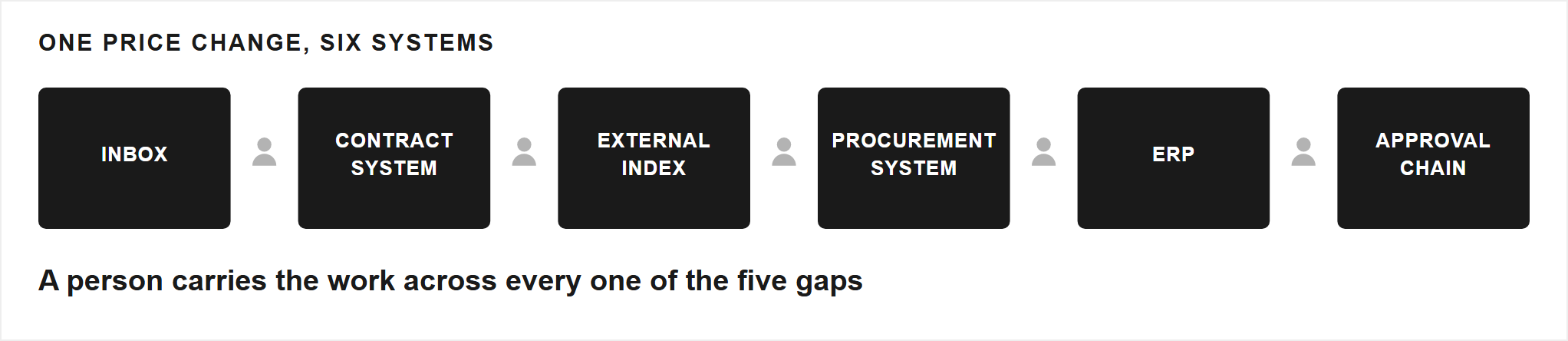
Those nine steps happen in six different places
Look at where that work actually took place.
- The email arrived in an inbox
- The terms were in the contract system
- The index was published on somebody else’s website
- The agreed price lives in the procurement system
- The order and the invoice sit in the ERP
- The approval ran through a chain of people, each of whom had to be asked, reminded and asked again
Six places. One price change.
Nobody designed it that way. Each of those systems was bought by a different function, on a different cycle and against a different set of requirements. Every one of them is good at what it does. Every one of them was a sensible purchase at the time.
What nobody bought was the thing that carries a case from one system to the next. That job went to a person by default, and it has stayed with a person ever since. It is the subject of the last article in this series.
You get the same equation every year
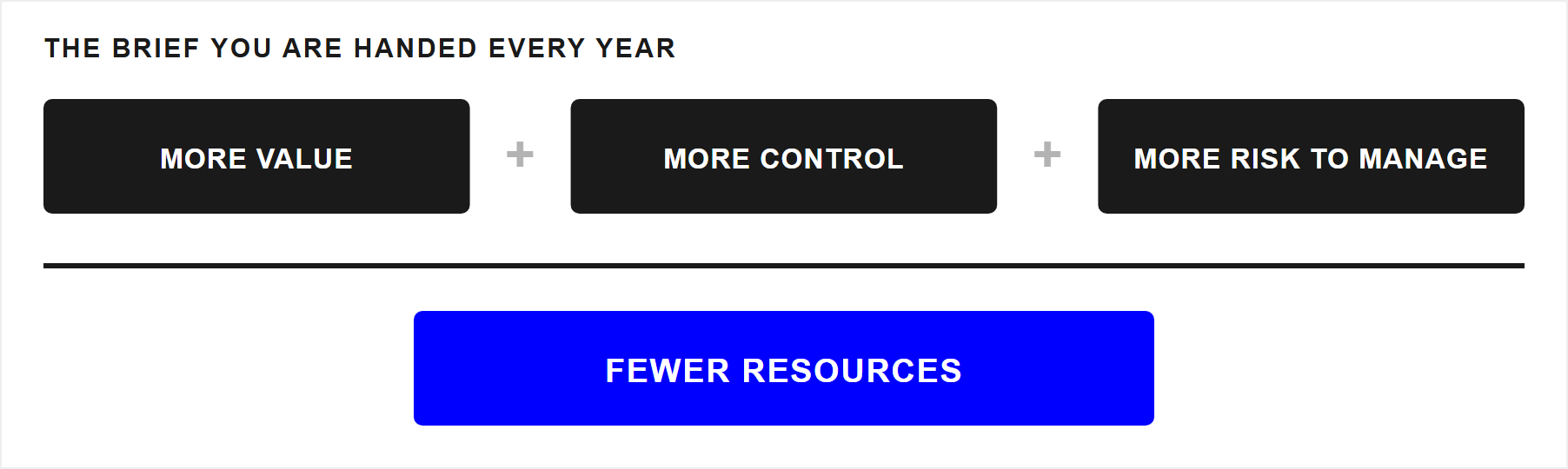
You are asked to deliver more value, hold more control and carry more risk, and to do all of it with fewer resources.
If you have worked in procurement or in finance for ten years, you have been handed some version of that every single year. Save more. Control more. Carry more risk, because there is always more risk. Do it with the same team, or with a smaller one.
That third term has grown the fastest. Nobody announced it. The list of things you are expected to know about a supplier now runs to ownership, sanctions exposure, financial health, certifications, sub-tier dependencies, sustainability and cyber posture. Every one of those arrived with a good reason attached. None of them arrived with extra people attached.
Here is the part that makes it interesting.
You are meeting the target. Deloitte’s 2025 survey of more than 250 chief procurement officers across 40 countries found that 86% of them met their cost savings targets.
So this is not a story about a function that fails at what it measures. You hit the number you negotiated. You can evidence it. The awkward question is a different one: what happened to everything you never got to?
The constraint is human attention
Your software is fine.
Your process design is fine and your team is good. I have spent a long time inside these functions, and the people in them are rarely the problem.
There is a finite amount of expert attention in your function every week. It is the scarcest resource you have and the most expensive one you buy. The work in front of you asks for more of it than exists.
That is the constraint. Budget, headcount and tooling all sit downstream of it.
Once you name it, a number of things stop being mysterious. Why savings you genuinely negotiated leak away quietly over the following two years. Why the supplier you screened at onboarding is still on the approved list three years later, under different ownership. Why a contract renewed on terms nobody had re-read.
None of that is negligence. It is arithmetic. Every one of those tasks was somebody’s job, and that somebody had a finite week.
You prioritise, you sample, you react
So what does a function do when the work exceeds the attention available to do it?
It does the only rational thing. It prioritises. It samples. It reacts.
It puts expert attention on the biggest contracts and the loudest problems. It checks part of the population and assumes the rest behaves the same way. And it waits for something to surface before it goes looking.
Every one of those is a good decision. I would make the same three. Given fixed attention and unbounded work, that is what a competent leader does, and anyone who tells you otherwise has not run a category.
You can watch it happen in the way an approved supplier list ages. Everyone on that list was checked properly on the day they were added, by someone doing a careful job. That check was a photograph of a single afternoon. Since then:
- Ownership has changed
- Certificates have lapsed
- A parent company has been bought by somebody you would not have approved
Nobody decided to stop looking. There was never a week when re-checking a supplier who had caused no trouble was the best use of the time.
But look at what each one costs.
- Prioritising means most of your spend receives no expert attention at all. It is not that it was reviewed and cleared. Nobody looked.
- Sampling means you judge the health of a whole population from a fraction of it, then report that judgement as though you had checked everything.
- Reacting means you find the problem after it has happened, and after it has cost you something.
This is your operating model. It is a good design for the shortage it was built around.
Count the two piles and price the bigger one
Go back to those nine steps and sort them into two piles. Eight of them are retrieval and checking: finding, reading, calculating, transferring, remembering and monitoring. One of them is a decision, which is whether you accept this increase, challenge it or negotiate.

That single question needs judgement, commercial instinct and a relationship with the supplier. It is the part your people are good at and never have enough time for.
You can run this on one process this week. It takes an afternoon and needs no budget. Pick something ordinary, such as a price increase, a supplier onboarding or a contract renewal. Choose one that happens often and that nobody in the room considers difficult.
Then three moves.
- Count the retrieval steps. Count every action that involves finding, reading, checking, calculating, transferring or chasing. Be honest about the ones that happen in somebody’s head or in a spreadsheet nobody owns.
- Count the steps that need judgement. These are the moments where a person weighs something and decides. In most processes there are far fewer of them than people expect. Naming them out loud is uncomfortable.
- Price the first pile. Loaded hourly cost of the people doing it, multiplied by the time it takes, multiplied by how often the process runs in a year.
That last number is what your organisation currently pays for retrieval on one process. It is usually the first time anybody has seen it as a single figure, and usually larger than the room expects.
Two things tend to happen when a team does this properly.
- The retrieval pile is longer than anyone guessed. The steps that live in somebody’s head never appear on a process map, so nobody counts them.
- The judgement pile contains steps that need no judgement. What they need is a rule an experienced person has applied for years without ever writing it down.
Then ask the only question that really matters about the list. Which of those steps genuinely required a person?
Only one kind of work needs you
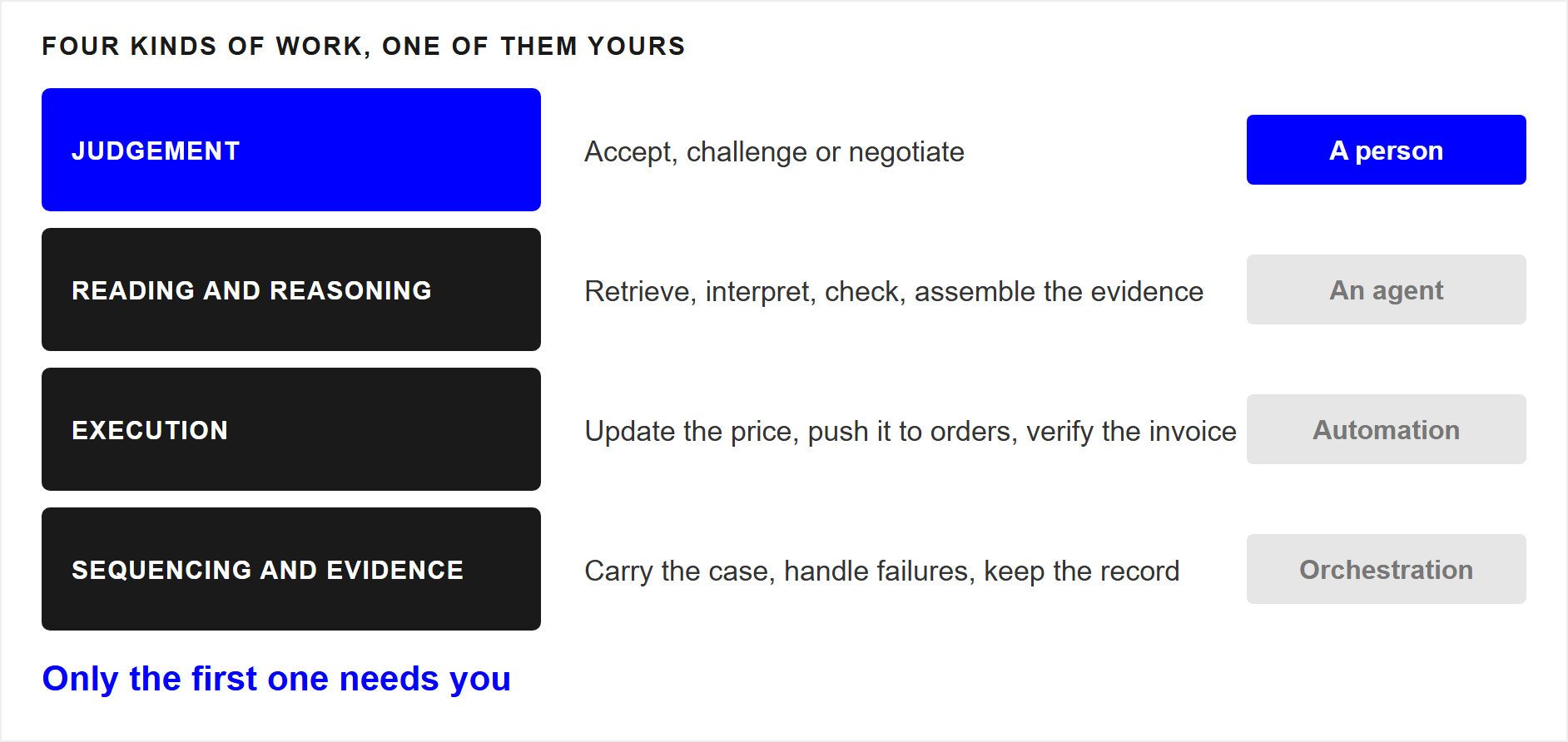
When a team answers that question honestly, the list stops being a sequence and starts being four different kinds of work. They are not interchangeable, and each of them has a different answer.
- Judgement. Accept, challenge or negotiate. This needs commercial instinct and a relationship with the supplier. It belongs to a person who is accountable for the category. It should stay exactly where it is.
- Reading and reasoning. Retrieving the contract, interpreting an indexation clause a lawyer wrote four years ago, checking the published index and assembling the evidence behind a recommendation. This used to require a person for one reason only, which is that reading was human work. AI agents now do this part reliably enough to run it on every case instead of a sample.
- Execution in your systems of record. Updating the agreed price, pushing it into future orders, checking that the invoices follow it. This is integration and automation, and most large organisations already own most of the pieces.
- Sequencing and evidence. Something has to carry a case across those six systems, decide what happens when a step fails, route the exception to the right person, and keep a durable record of who decided what and on what basis. This is orchestration. Almost nobody owns it.
That last one is where the interesting failure lives. Look again at where the work sat. The email arrived at the front of your business, inside a supplier relationship that a named person owns. The consequence landed at the back, as a purchase order, an invoice and a payment in your finance systems. Those nine steps crossed the line between your front office and your back office four times. Each time, a person picked something up and carried it.
Most large organisations have automated pieces on both sides of that line. Very few own the crossing itself, which is where the time goes and where the errors surface.
None of this comes for free. Agents that read contracts have to be governed. They have to be monitored, corrected when they drift, tested against the decisions your best people actually make, and answerable when somebody asks why a recommendation came out the way it did. Capacity you cannot govern is not capacity. It is exposure, and you already have enough of that.
That is the work my colleagues and I do at Digital Workforce. People, AI agents and automation running as one governed flow across the systems a business already owns, from the front office through to the back. We operate it, so somebody is accountable on the day it drifts.
Where does your team spend its attention this week?
Next Monday, that supplier email arrives again. Someone will handle it well. It will take most of a morning.
The pressure your function is under has not changed much in forty years. What has changed, quite recently, is what it costs to pay attention to something, and that is what the rest of this series is about.
The next piece asks an uncomfortable question. Procurement has bought wave after wave of technology since the 1980s, and every one of those waves was worth buying. I would buy all of them again. So why is that same equation still sitting on your desk?
Before then, here is one question to take back to your team. Of all the expert attention your function will spend this week, how much of it will land on an actual decision?
If you want to take it further
On 30 September I am joining Brian Halpin of SS&C Blue Prism for a session on this, starting from a supplier price increase.
If you have run the count on one of your own processes, bring it. The discussion is usually more useful than the slides.
Sources
Deloitte’s 2025 Global Chief Procurement Officer Survey establishes that 86% of CPOs met their cost savings targets. The survey covers more than 250 CPOs across 40 countries, and the figure is self-reported. deloitte.com
The 4.8% price increase, the nine steps and the six systems are an illustrative example drawn from a common procurement scenario. They are not a customer figure and not a benchmark.
About the author
Stefan Meller is Principal Account Executive for Enterprise and Public at Digital Workforce.