
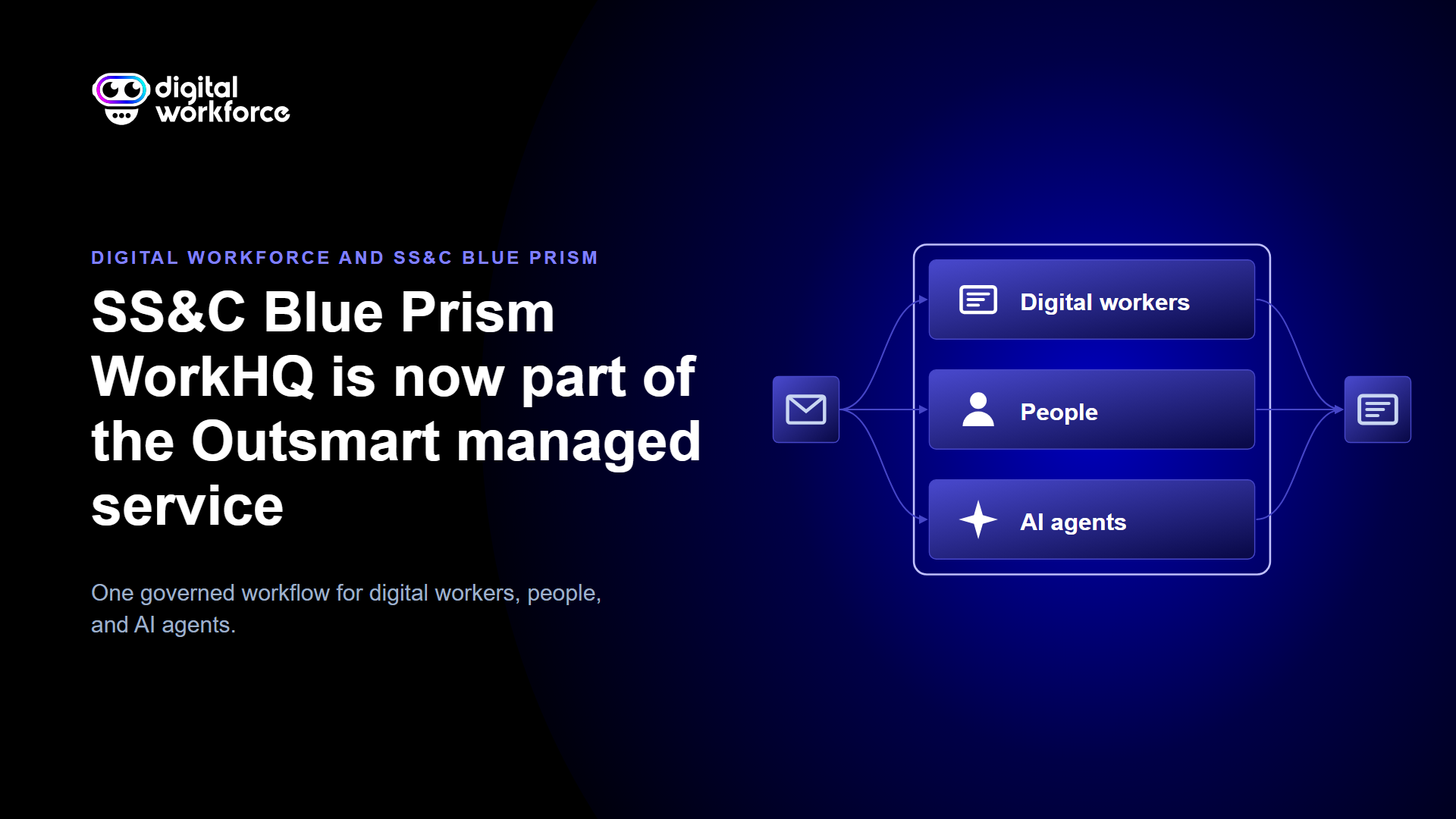
Digital Workforce now offers SS&C Blue Prism WorkHQ as part of the Outsmart managed service
Every automated process has steps that still wait for a person. An order arrives with an attachment that does not match the template. A service request needs someone to check a document. Someone has to compare an application with a record in another system before it can move on. The rules-based part of the process runs in seconds. The case then waits in a queue until someone has time to look at it.
Those judgement steps often set the pace for the whole process. Workflow orchestration puts those steps in one managed process with digital workers, and that alone opens up new automation use cases. AI agents can then take on the checking and classifying around them and raise the level of automation further.
In October 2026, Digital Workforce signed a Managed Services Platform agreement with SS&C Blue Prism. Under the agreement, Digital Workforce offers SS&C Blue Prism WorkHQ as part of the Outsmart managed service. Outsmart is Digital Workforce's cloud managed service platform. Digital Workforce designs the workflows, builds the AI agents where a process calls for them and runs the service in production.
Judgement steps slow down rules-based automation
Rules-based automation works best on structured, repeatable steps. A Blue Prism digital worker runs the same steps in an application every time: log in, copy the data, update the system of record. That reliability makes it a good fit for core processes.
The steps around that core are less tidy. Inputs arrive as emails, scanned documents and free-text forms. Data in one system does not quite match data in another. Some cases need a decision that a fixed rule cannot make. In most automation programmes, these exceptions go to a work queue for people to handle.
People then spend part of their day preparing cases. They open attachments, look up records and copy details from one screen to another. Only then can they make the actual call. The more exceptions a process produces, the longer the queue becomes.
A workflow changes how that human work is organised, with or without AI. Each case runs as one workflow, so its steps and data stay together and the person handling it sees the context with the task. Exceptions follow a defined route to the right person.
AI agents can then process much of the case preparation. Bringing workflows and agents into production raises three practical questions:
- Coordination: how digital workers, people and AI agents work in the same process
- Control: how a team governs the use of AI models
- Operation: who builds, monitors and maintains the result
SS&C Blue Prism WorkHQ addresses the first two. The Outsmart managed service from Digital Workforce addresses the third.
WorkHQ routes each step to the right resource
SS&C Blue Prism unveiled WorkHQ in April 2026 as its agentic automation platform. SS&C describes it as a single control plane for people, AI agents, APIs and digital workers in one governed environment.
A WorkHQ workflow sends each step of a process to the resource suited to it:
- Digital workers run exact, repeatable steps, such as updating a core system.
- AI agents process unstructured content and return a suggested next step within limits the business sets.
- People step in at the control points the organisation sets. A control point can sit at any step where a person is wanted or required, whether the stakes are high or low. Cases arrive in their task inbox with the context attached.
- Connectors link the workflow to business systems through their APIs. SS&C offers hundreds of prebuilt connectors.
A workflow can start on a schedule or when something happens. The trigger can be a file update, a data change, a form submission or an API call.
Two further WorkHQ capabilities support daily operation:
- Digital worker recovery. As an example, WorkHQ can restart the machine of a stalled digital worker. The process can recover from that failure without anyone stepping in.
- Controlled releases. The Process Repository keeps every version of a workflow. Changes reach production in planned stages, so a team can trace what changed and when.
Existing Blue Prism automations stay in use. Digital workers on Blue Prism version 7.4 or later connect to WorkHQ workflows.
Workflow orchestration creates value with or without AI
AI is optional in a WorkHQ workflow. The starting value can come from connecting existing automations, people and systems in one managed process. Individual steps can use rules, AI or human judgement, and the handovers, controls and responsibility stay clear. This results in fewer manual handovers and faster completion in work such as:
- Connected automation. A workflow collects information, validates it, updates the systems and notifies the people involved.
- Approvals and exceptions. Automated processing stops for a person to review and resumes once the decision is made.
- Responsive digital workers. Triggers start digital workers when work arrives, with less manual scheduling.
This matters where an organisation is not ready to use AI in a process just yet. A healthcare organisation with open questions about AI is one example. Digital Workforce can add AI agents to the same workflow later, which raises the level of automation in the steps people still prepare by hand.
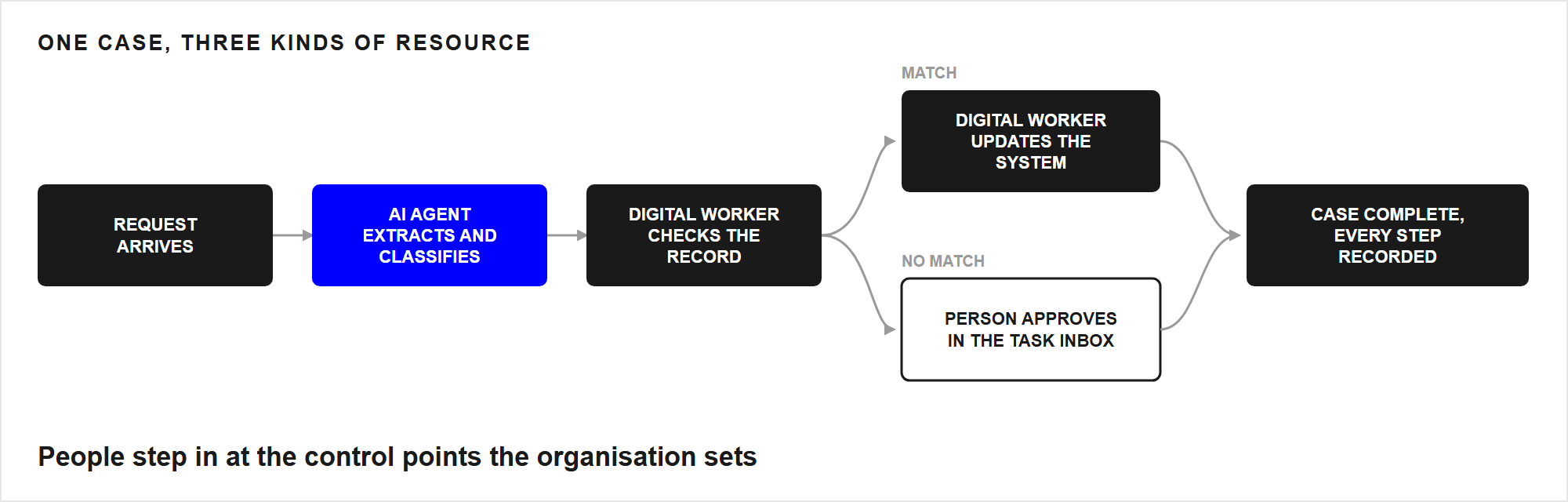
An example of one case moving through WorkHQ
Illustrative example. The steps vary by process.
- A request arrives by email with two attachments, and the email starts a WorkHQ workflow.
- An AI agent extracts the key fields from the attachments and classifies the request.
- A digital worker looks up the matching record in the core system and compares it with the extracted data.
- When the data matches, a digital worker completes the update in the system of record.
- When the data does not match, the workflow routes the case to a person's task inbox. The extracted fields, the system record and the agent's suggested outcome arrive with it.
- The person approves or corrects the case. A digital worker then completes the update.
- WorkHQ records each step. SS&C AI Gateway records each call the agent made to an AI model.
The person in step 5 makes one decision with the facts in front of them. The preparation work happens before the case reaches them. Without an AI agent, a person handles the extraction first. The workflow still routes the case and records each step.
SS&C AI Gateway puts a control point between agents and AI models
Risk, audit and compliance teams ask one question about AI agents early on. Can the team show what the agent did with the AI model?
SS&C AI Gateway gives that control point. Every request that an agent built in WorkHQ makes to an AI model passes through the gateway. The gateway:
- detects and redacts personal data before it reaches the model
- blocks prompt-injection attempts
- applies role-based access control, so only approved users and applications reach each model
- writes each interaction to an audit trail
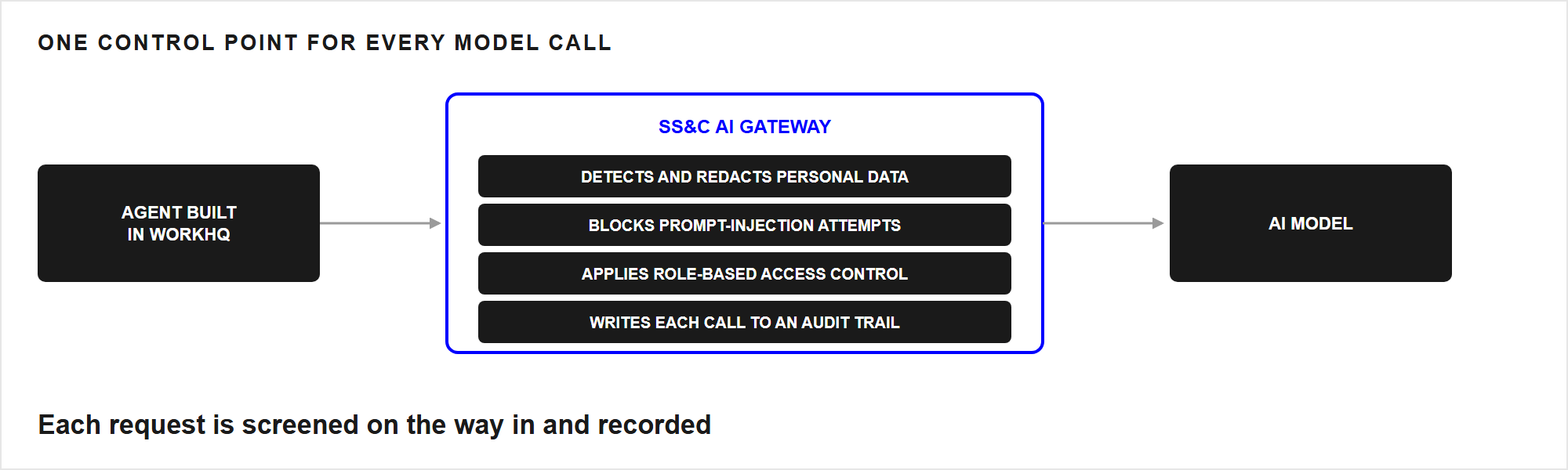
WorkHQ keeps its own log of each workflow step. Together, the two records let an auditor follow a case from the first trigger to the final decision.
SS&C AI Gateway is available as part of the WorkHQ service from Digital Workforce.
WorkHQ is now part of the Outsmart managed service
The Outsmart managed service covers the full lifecycle of an automated process. With the new agreement, WorkHQ is part of that service.
- Design. Digital Workforce assesses the process and finds the steps where workflows, approval points and agents help. The AI Agent Discovery Assessment identifies high-value AI use cases and creates a roadmap.
- Build. Digital Workforce builds the WorkHQ workflows and the digital workers. Where a process uses AI agents, Digital Workforce builds them either in WorkHQ's Agent Studio, or as standalone AI agents. Each new process passes quality acceptance before it enters production.
- Run. The Digital Workforce Run Management team monitors processes around the clock. It handles incidents and problems under ISO/IEC 20000-1 processes. It also makes standard changes when a target application changes.
- Capacity. The digital workers run on Outsmart. SS&C hosts and maintains the WorkHQ platform itself.
WorkHQ is part of the Outsmart service. The customer has no separate WorkHQ licence to buy or manage. The offer covers every market where Digital Workforce operates.
The service supports both a focused start and a larger deployment. An organisation can begin with a limited use case or a pilot, with a starting commitment tailored to that use case, and expand as adoption grows. Another can start with a broad adoption from the outset.
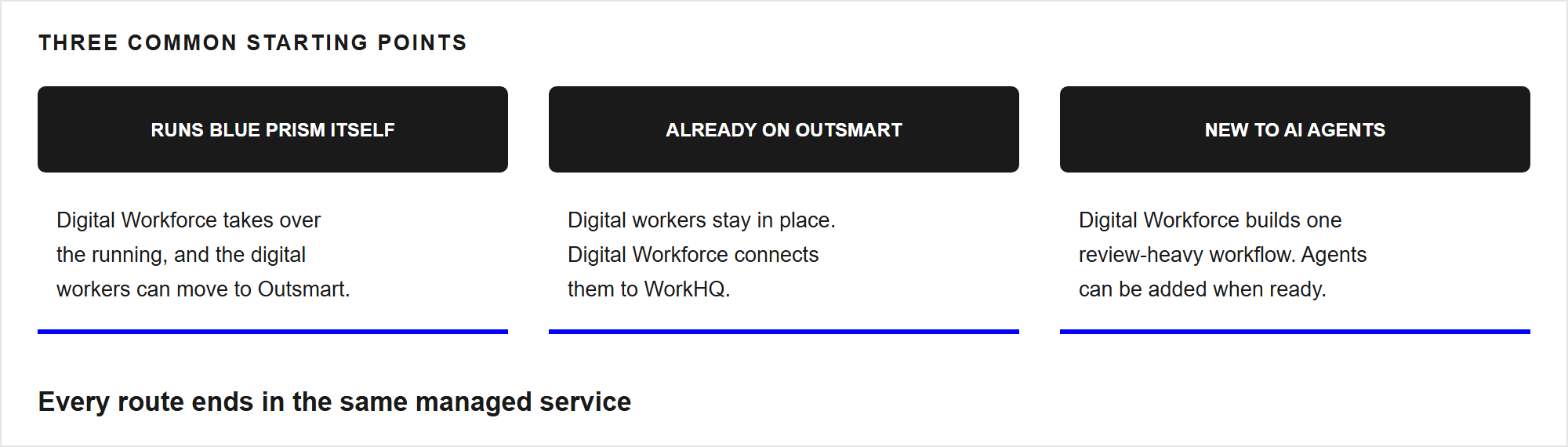
Three common starting points
An organisation may run Blue Prism itself today. Its team owns the servers, the support and the upgrades. Digital Workforce can take over the running of the current automations. The digital workers can move to Outsmart. Digital Workforce then adds WorkHQ workflows, with agents where judgement steps hold the work up.
An organisation may already run Blue Prism on Outsmart. Its digital workers stay where they are. Digital Workforce connects them to WorkHQ and adds agents and approval steps to the workflows that need them.
An organisation may not use AI agents yet. A good first process is one where people spend a large part of the day reviewing, checking or sorting cases. Digital Workforce builds that process as a WorkHQ workflow for digital workers and people. When the organisation is ready to adopt AI, Digital Workforce adds AI agents to the same workflow, and SS&C AI Gateway can be put in place from the first agent. Digital Workforce runs the process as part of the Outsmart managed service.
SS&C hosts WorkHQ, and Digital Workforce runs the work on it
SS&C Blue Prism builds, hosts and maintains the WorkHQ platform. Digital Workforce designs the workflows, builds the agents and runs the digital workers in production. One service agreement with Digital Workforce covers both.
Digital Workforce has built and run automation on SS&C Blue Prism since 2015. In 2020, Digital Workforce became the first service provider in EMEA to reach Blue Prism Platinum certification. Today Digital Workforce holds SS&C Blue Prism Implementation Platinum and Managed Service Provider Gold certification.
Digital Workforce holds ISO/IEC 20000-1 certification for service management and ISO/IEC 27001 certification for information security.
Frequently asked questions
A 60-minute review shows where workflows and agents fit
Digital Workforce offers a 60-minute WorkHQ review. It covers the current Blue Prism automations and the steps where workflows, approval points and agents would help. It also confirms the Blue Prism version and any upgrade needed. The review ends with a named first process and the steps to bring it into the Outsmart managed service.